Fast Fashion Apparel: What It Is, How to Spot It, and What It Actually Costs
The global apparel industry is a $1.7 trillion sector that employs over 300 million people and produces more than 100 billion garments every single year. Roughly 36% of all clothing purchases worldwide now fall under the fast fashion category, making fast fashion apparel one of the largest and fastest-growing segments of the entire industry.
But what exactly makes a piece of clothing “fast fashion apparel” rather than just an affordable garment? The answer has nothing to do with price alone. It has everything to do with how the clothing is designed, what it is made from, how quickly it is produced, and how long it is expected to last.
This page breaks down what fast fashion apparel actually looks like, how it differs from premium and sustainable alternatives, how to evaluate specific apparel companies, and what your options are if you want to stop buying into the cycle.
What Is Fast Fashion Apparel?
Fast fashion apparel is clothing that is mass-produced at extreme speed and sold at low prices to capture trending styles before they fade. It is not defined by a single brand or store. It is defined by the production model behind it.
Here is what that model looks like in practice.
The design is not original. It is replicated. Fast fashion apparel brands do not invest in long-term creative direction. They monitor runway shows, celebrity outfits, and viral social media trends, then produce simplified, budget-priced imitations within days or weeks.
The materials are cheap and synthetic. Over 60% of all clothing produced today is made from petroleum-derived synthetic fibers like polyester, nylon, and acrylic. These materials are favored because they are inexpensive to manufacture at scale and do not depend on agricultural growing seasons. They are also non-biodegradable plastics that shed microplastics into waterways every time they are washed.
The construction is minimal. Stitching density is also reduced. Zippers are plastic instead of metal. Linings are eliminated. Buttons and pockets are sometimes removed entirely to save fractions of a cent per unit. The result is clothing that looks acceptable on arrival but loses shape, pills, fades, or tears after a handful of wears.
The volume is enormous. Fast fashion apparel companies do not produce clothing to meet demand. They overproduce to flood the market. The fashion industry manufactures over 100 billion items per year. Between 10% and 40% of those items are never sold or worn before being discarded or destroyed.
The lifecycle is deliberately short. Fast fashion garments are worn an average of fewer than seven to ten times before being thrown away. Trend-driven party tops are worn an average of just 1.7 times. Since 2000, consumers have been buying 60% more clothing but keeping each item for half as long.
That is the core of the fast fashion apparel market: high speed, low quality, massive volume, and a business model that depends on you replacing your wardrobe constantly.
How to Identify Fast Fashion Apparel
Not sure whether something you are looking at is fast fashion? Here are the signals.
Check the fabric composition label.
If the garment is made primarily from polyester, nylon, acrylic, or elastane blends with minimal natural fiber content, it is produced from the same synthetic base that most fast fashion relies on. This does not automatically make it fast fashion, but combined with the other signals below, it is a strong indicator.
Look at the price relative to what you are getting.
A fully constructed jacket for $25 or a pair of trousers for $12 means the costs of materials, labour, and transportation have been compressed to a point that raises questions about what was sacrificed. When a garment is priced well below what its construction would logically cost, someone or something in the supply chain is absorbing the difference.
Check the release frequency.
If the brand’s website or store features hundreds of new items every week (or thousands every day), the company is operating on a fast fashion production model regardless of how it positions itself. Traditional apparel companies release seasonal collections. Fast fashion apparel retailers release micro-seasons weekly. Ultra-fast platforms like Shein release thousands of new items daily.
Evaluate durability before you buy.
Hold the fabric up to light. If you can see through it, the material weight is too low for the garment to last. Check the stitching at seams. If threads are loose or spacing between stitches is wide, construction was rushed. Pull gently on seams. If they separate under light pressure, the garment will not survive regular wear.
Look for third-party certifications
Genuine sustainable apparel carries independent verification: GOTS, Fair Trade, OEKO-TEX, bluesign, or B Corp. If a brand labels its products “eco-friendly” or “conscious” without any of these certifications, the claim is marketing, not evidence.
The Fast Fashion Apparel Market: How Big Is It?
Fast fashion is growing faster than the entire apparel industry.
The global fast fashion apparel market is valued at approximately $178 billion in 2026 and is projected to reach $388 billion by 2034, growing at a compound annual rate of roughly 10%.
For context, the total global fashion apparel industry is worth $1.7 trillion. Fast fashion represents a disproportionately fast-growing share of that market, driven by ultra-fast e-commerce platforms, social media trend acceleration, and the continued expansion of low-cost manufacturing capacity in developing nations.
By product type: Casual wear dominates fast fashion apparel at roughly 55% of the market. Formal wear is the fastest-growing segment, expanding at over 10% annually as more consumers buy occasion clothing they intend to wear only once or twice.
By consumer segment: Women’s apparel accounts for approximately 62% of all fast fashion sales. The men’s segment is growing fastest at over 10% annually, driven by the expansion of trend-driven men’s lines and capsule collections.
By distribution: Physical retail stores still account for roughly 71% of fast fashion apparel sales. But online channels are growing at over 11% annually, driven by app-based platforms, social commerce, and direct-from-factory shipping models.
Evaluating Major Apparel Companies on Fast Fashion
One of the most common questions people ask about specific clothing brands is whether they qualify as fast fashion. The answer depends on how the company produces, prices, and cycles its inventory, not on how it markets itself.
Here is how some of the most frequently asked-about apparel companies stack up.
Zara (Inditex)
Verdict: Fast fashion pioneer.

Zara invented the modern fast fashion apparel model. The brand compressed the design-to-shelf pipeline from several months to 15 days when it launched in the early 1990s. Today, Zara produces an estimated 450 million to 840 million garments per year across nearly 3,000 stores. Its parent company, Inditex, used over 705,000 metric tons of raw materials in 2025 alone.
Zara’s denim line uses the same compressed production timelines as the rest of its range. While Inditex has made investments in recycled fiber initiatives, the company’s total production volume continues to rise, which undercuts per-garment efficiency gains. The brand’s “Join Life” sustainability labels have been flagged in investigations for referring to the tag material rather than the garment.
H&M
Verdict: Fast fashion at massive scale.
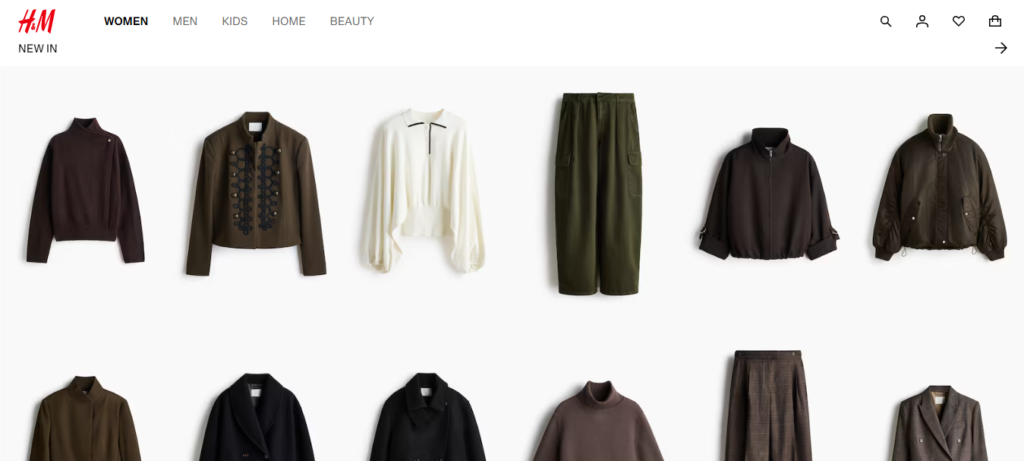
H&M is the world’s second-largest apparel retailer, producing roughly 3 billion garments annually across over 4,000 stores. In 2025, the company used 506,015 metric tons of raw materials and reported holding nearly $4.1 billion in unsold inventory in recent years.
H&M’s “Conscious” collection, intended to signal sustainability, was found in testing to contain a higher proportion of synthetic fibres than its standard line. The brand offers in-store garment recycling bins and a 15% discount voucher for donations, but less than 1% of collected clothing globally is recycled into new garments.
Gap
Verdict: Fast fashion mechanics under a basics brand exterior.
Gap was one of the original mass-market apparel retailers. While it positions itself as casual basics rather than trend-chasing, Gap operates high-volume production through global supply chains concentrated in Bangladesh, Vietnam, and China. The brand’s inventory cycles, synthetic fabric ratios, and promotional pricing structures (near-permanent markdowns) align with fast fashion operating patterns. Its sub-brands Old Navy and Banana Republic operate on the same supply chain infrastructure.
Abercrombie & Fitch
Verdict: Fast fashion with lifestyle branding.
Abercrombie & Fitch and its sub-brand Hollister operate high-turnover retail models with frequent new drops and heavy promotional pricing. The company has faced controversies over discriminatory hiring practices, marketing ethics, and supply chain labour conditions. Its denim line competes directly with fast fashion price points and follows the same rapid seasonal refresh cycle.
Levi’s
Verdict: Grey area, leaning traditional but with caveats.
Levi’s occupies a complicated position in the apparel landscape. It is not a fast fashion brand by production speed or trend-chasing metrics. Levi’s designs denim with multi-year wearability in mind, and the company has made meaningful water-reduction commitments (its Water<Less technology claims to reduce water use by up to 96% in finishing).
However, Levi’s still produces at scale through global manufacturing networks with documented labour issues, and the brand participates in heavy promotional discounting cycles that lower the perceived value of its garments. It is a better option than most fast fashion denim, but it is not a certified sustainable apparel company.
Dickies
Verdict: Workwear with fast fashion production patterns.
Dickies (owned by Kontoor Brands) produces durable workwear and casualwear. Its products are generally built for longer wear cycles than typical fast fashion, but the brand manufactures at high volume through global supply chains with limited transparency. Dickies does not hold major third-party sustainability certifications. It sits closer to the traditional mass-market apparel category than to fast fashion, but it does not qualify as sustainable or ethical apparel either.
Carhartt
Verdict: Traditional workwear, not fast fashion, but not certified sustainable.
Carhartt produces heavy-duty workwear designed for durability and multi-year use, which fundamentally distinguishes it from the fast fashion production model. Garments are built heavier, with reinforced stitching and thicker fabrics. However, Carhartt manufactures through global supply chains and does not carry major third-party environmental or labour certifications. It is not fast fashion by operating model, but it is not a verified ethical apparel brand either.
Diesel
Verdict: Premium positioning, but production model raises questions.
Diesel markets itself as premium denim and casualwear, pricing significantly above typical fast fashion. However, the brand has accelerated its release cadence and expanded into trend-driven collections that follow seasonal fashion cycles more closely than its original workwear-adjacent positioning suggested. Diesel’s denim quality generally exceeds fast fashion standards, but its production transparency is limited.
Madewell
Verdict: Fast fashion adjacent.
Madewell, owned by J.Crew Group, markets itself around denim and timeless basics. In practice, Madewell operates on accelerated production timelines with offshore manufacturing and has experienced well-documented quality deterioration. The brand shares J.Crew’s supply chain infrastructure. While not as extreme as Shein or Boohoo, Madewell operates closer to the fast fashion model than its marketing suggests.
Ariat
Verdict: Speciality performance apparel, not fast fashion.
Ariat produces equestrian, western, and outdoor performance footwear and apparel. Its products are designed for durability in demanding conditions, and the brand does not operate on trend-driven micro-season cycles. Ariat is not fast fashion by production model, though its supply chain transparency could be stronger.
American Apparel
Verdict: Historically unique, now complicated.
American Apparel originally distinguished itself by manufacturing domestically in Los Angeles, paying above-minimum wages, and avoiding offshore production. That model collapsed with the company’s bankruptcy. Under subsequent ownership, the brand relaunched with a different supply chain. Current American Apparel production does not carry the same domestic manufacturing commitments that defined the original company. Its fast fashion status depends on which era of the brand you are evaluating.
Los Angeles Apparel
Verdict: Not fast fashion by production model.
Los Angeles Apparel was founded by American Apparel’s original founder and manufactures in Los Angeles with domestic labour. The brand produces basics and blank apparel at volume but pays above-minimum wages and maintains shorter, more transparent supply chains than typical fast fashion. It is not fast fashion by operating model, though its sustainability credentials are self-reported rather than independently certified.
Poncho (Apparel)
Verdict: Limited data available.
Poncho does not have sufficient publicly available supply chain, labour, or production data for a definitive fast fashion evaluation. When a brand lacks transparency about where and how its clothing is made, that absence of information is itself a signal worth noting.
Athleta
Verdict: Better than typical fast fashion, but not fully sustainable.
Athleta (owned by Gap Inc.) is a Certified B Corporation, which means it has passed a rigorous independent audit of its social and environmental performance. This places it meaningfully ahead of most fast fashion apparel brands. However, Athleta still operates under Gap Inc.’s broader supply chain, uses synthetic performance fabrics, and produces at commercial scale. B Corp certification is a real credential, but it does not exempt the brand from scrutiny on material choices and production volume.
How CPG and Premium Apparel Brands Are Competing with Fast Fashion
The rise of fast fashion has forced every segment of the apparel industry to respond.
Premium apparel retailers have historically competed on quality, craftsmanship, and brand heritage. But as fast fashion has compressed the price gap (with brands like Zara offering trend-driven pieces at $34 average and Shein at $14), premium brands face pressure to accelerate their own production cycles, increase promotional frequency, and lower price entry points. The differences between fast fashion and premium apparel retailers on quality and pricing are narrowing in some categories, even as the underlying production ethics diverge.
CPG (consumer packaged goods) apparel brands, including private-label lines from retailers like Target, Walmart, and Amazon, compete with fast fashion by leveraging existing distribution infrastructure and brand trust. Their private-label fashion lines (Target’s Wild Fable, Amazon’s The Drop) use similar production models to fast fashion but benefit from established logistics, customer data, and omnichannel reach.
Emotional apparel brands that build loyalty through storytelling, community, and values-driven positioning (think Patagonia, Reformation, or Everlane) compete with fast fashion not on price or speed but on meaning. The comparison between emotional apparel brands and fast fashion reveals a fundamental difference: one model sells identity and values, the other sells volume and trend access.
What Is the Best Fast Fashion Retailer for Trend-Driven Women’s Apparel?
This is one of the most searched questions in the apparel space, and it deserves an honest answer.
If you define “best” purely by trend speed, price, and selection volume, Shein currently dominates. It adds thousands of new women’s styles daily at an average price of $14 per item. No other fast fashion apparel retailer matches its combination of speed, variety, and low cost.
But “best” should account for what the price does not include. Shein’s production model operates through over 5,000 contract factories with limited supply chain auditing (covering roughly 36% of its manufacturers). The platform has faced over 100 copyright lawsuits, a €1 million fine for misleading environmental claims, and persistent scrutiny over labour conditions.
If the question is “which fast fashion retailer gives me the most trend-driven women’s apparel for the least money,” the answer is Shein. If the question is “which option lets me buy trend-driven clothing without contributing to documented labour exploitation and environmental harm,” the answer is not any fast fashion retailer. It is secondhand platforms, rental services, or certified sustainable brands.
Alternative Apparel: Replacing Fast Fashion Without Giving Up Style
Leaving fast fashion does not mean wearing beige linen forever. It means redirecting where your clothing comes from and how long you keep it.
Here are the categories of alternative apparel that replace fast fashion basics without sacrificing style or accessibility.
Certified ethical basics. Brands like Pact (Fair Trade, GOTS-certified organic cotton), Kotn (Certified B Corp, Egyptian cotton with non-toxic dyes), and Quince (BSCI-certified factories, virgin-plastic-free packaging) produce everyday wardrobe staples at accessible prices with verified supply chains.
Durable denim. Nudie Jeans Co crafts jeans from 100% organic cotton and offers free lifetime repairs. Warp + Weft is a vertically integrated, size-inclusive denim brand that recycles 98% of its manufacturing water. Both produce denim designed to last years, not weeks.
Performance and activewear. Girlfriend Collective constructs activewear from recycled plastic bottles in SA8000-certified ethical factories. Patagonia uses recycled materials and organic cotton, operates the largest garment repair facility in North America, and runs the Worn Wear secondhand resale programme.
Secondhand and rental. Digital resale platforms like Depop, Vinted, ThredUp, Poshmark, and Sellpy give existing garments a second life. Clothing rental platforms like Rent the Runway provide access to occasion wear without the waste of single-use purchasing.
Next-generation materials. Emerging bio-materials like AppleSkin, Piñatex (pineapple fibre), Desserto (cactus leather), Mylo (mushroom leather), and Vegea (grape leather) are beginning to offer petroleum-free alternatives to synthetic fast fashion fabrics.
For the full researched list, see: Non-Fast Fashion Brands and Alternatives →
The Real Valuation of Fast Fashion Apparel
The fast fashion apparel market is valued at $178 billion today. But that valuation only measures revenue. It does not account for the costs the industry externalizes.
Environmental costs. The fashion industry generates 92 million tonnes of textile waste per year, accounts for 8% to 10% of global carbon emissions (1.2 billion tonnes of CO₂ annually), consumes 79 trillion litres of water, produces 20% of global industrial wastewater, and contributes 35% of all primary ocean microplastics.
Human costs. Over 60 million garment workers worldwide, roughly 80% of them women, produce fast fashion apparel. In Bangladesh, the legal minimum wage is $97 to $133 per month against a living wage starting at $250. In domestic US factories supplying brands like Forever 21, workers were found earning $4 an hour.
Waste costs. Between 10% and 40% of all manufactured clothing is never sold. Brands frequently destroy unsold inventory rather than discount it. Returned online orders are routinely incinerated because reprocessing costs exceed the garment’s value.
When you factor in these externalized costs, the fast fashion apparel valuation tells a different story. The $178 billion market is profitable specifically because it does not pay for the environmental damage, the living wages, or the waste management that its business model generates. Garment workers, ecosystems, and communities in the Global South absorb those costs.
That gap between what consumers pay and what the clothing actually costs is the defining tension of fast fashion apparel. Everything on this site exists to document it.
Where to Go from Here
See which brands operate this way. Our complete list covers every major fast fashion brand operating today, from ultra-fast platforms to mainstream high-street chains.
[Fast Fashion Brands: The Complete List →]
Understand how the model works. The full explainer on what fast fashion is, where it came from, and how the business model operates.
[What Is Fast Fashion? →]
Read the environmental data. Emissions, water, waste, microplastics, and chemical pollution, broken down with sourced figures.
[Environmental Impact of Fast Fashion →]
Explore brands that work differently. A researched guide to non-fast fashion alternatives, sorted by category and price range.
[Non-Fast Fashion Brands and Alternatives →]
Learn what structural change looks like. Policy, regulation, industry shifts, and what individuals can do that moves the needle.
[Solutions to Fast Fashion →]